
Internet Marketing and AI blog
The impact of top‑of‑funnel content on bottom‑funnel engagement and conversions
💡 Scroll to the bottom for a list of the sources referenced in this article.
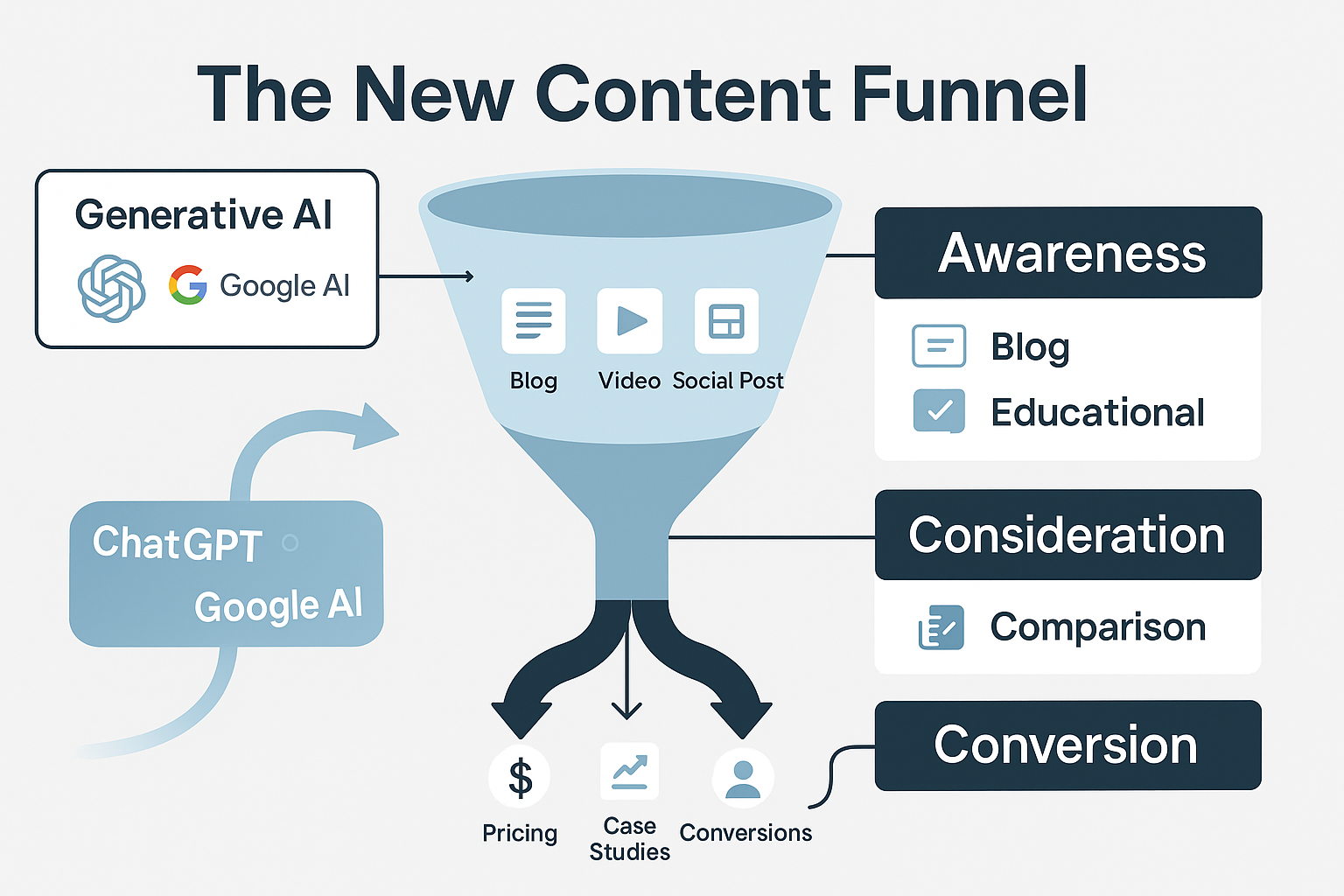
You’ve probably been hearing a lot about "full-funnel" marketing lately, with different studies out pointing to user behavior changes in the LLM-driven search era. In digital marketing, Top-OF-Funnel (TOFU) content refers to all that educational, awareness-stage material – blog posts, how-to guides, and videos – that attracts potential customers.
Bottom-OF-Funnel (BOFU) is where the action is: the later stages where prospects are comparing options, evaluating pricing, or ready to convert.
A key question for marketers is: How much do those early TOFU touchpoints (where you might not even get a click) actually influence later BOFU behaviors and conversions?
Let's cut through the noise. Recent research – both academic and industry – overwhelmingly indicates that strong TOFU content plays a crucial role. It builds the brand awareness, trust, and recall that, in turn, boosts engagement and conversion at the bottom of the funnel.
Below, we’ll summarize findings that demonstrate this relationship, and also discuss how emerging generative AI engines are changing this dynamic.
TOFU content builds brand awareness, trust, and recall
Top-of-funnel content is fundamentally about brand exposure and credibility-building.
By providing valuable information with no immediate sales pitch, brands earn the attention and confidence of potential buyers early on. Multiple studies show this translates into measurable downstream benefits:
- Brand awareness translates to sales: This isn't just a "fluffy" metric. Nielsen’s marketing analytics research has quantified a direct link between brand awareness and sales outcomes. According to a 2022 Nielsen report, a 1-point gain in brand awareness drives a 1% increase in sales. In other words, when more people know and remember your brand (often thanks to TOFU content), you reap more conversions. Neglecting TOFU brand-building is “not sustainable for long-term growth.”
- Trust and thought leadership: This is where it gets really interesting. Educational content at the top of the funnel significantly boosts brand trust. In an experiment by SEO firm Conductor, consumers who read an educational article from a brand were far more likely to trust that brand and buy from it. Immediately after consuming a TOFU piece, consumers were 131% more likely to purchase from that brand compared to a control group. Even one week later, they remained 48% more likely to buy.
- Perhaps most striking, when asked to choose among competing brands, 83.6% of consumers chose the brand that provided useful educational content – even if it was a “mock” brand they’d never heard of before. (admittedly, I found this part surprising) This study also found that trust and affinity increased over time. The positive impression created by TOFU content actually “compounds with time.” In short, helpful early-stage content plants a seed of goodwill that grows into greater trust, which benefits conversion efforts.
- Academic Evidence – Content’s Role in the Funnel: This isn't just industry folks patting themselves on the back. Academic research mirrors these findings. A 2019 study by Colicev et al. found that firm-generated content (FGC – content produced by the brand) was particularly effective at moving consumers from consideration to purchase intent. As another example, the Edelman/LinkedIn B2B Thought Leadership Impact report underscores that this kind of content can directly bolster trust. In their 2025 survey, 71% of decision-makers say that high-quality thought leadership is more effective than traditional marketing materials at demonstrating a supplier’s expertise.
All of these findings reinforce a key point: TOFU content builds the foundation of trust, credibility, and brand recall that makes later conversion possible.
Influence of TOFU content on BOFU engagement & conversion
Okay, so TOFU makes people like your brand. But does it make them buy?
Yes. Early-funnel content doesn’t just make people like your brand – it ultimately encourages them to take bottom-funnel actions. Several studies have attempted to quantify the downstream impact:
- Increased Likelihood of Conversion: The Conductor study above clearly demonstrated this conversion uplift (131% immediate lift in purchase intent). To put it simply, people are far more likely to become customers if they’ve consumed your educational content first. As Rand Fishkin noted in response to the research, “content that engages your audience also helps open their wallets.” This shows that TOFU content creates an engagement “halo effect” that carries over to the point of purchase.
- Another industry survey corroborates this: according to DemandGen/Brandtrust data, 60% of B2B buyers say that digital content (articles, videos, etc.) directly influenced their final purchase decision. In the same report, 50% of B2B buyers consumed at least 8 pieces of content in the course of making a purchase.
- Lead Generation and Sales Pipeline: We all know content marketing is a driver of leads. In fact, 70% of B2B marketers surveyed by the Content Marketing Institute said content marketing has been effective at generating leads, and 63% said it helps drive sales directly. By the time someone is searching for pricing (a classic BOFU behavior), they often have already been “nurtured” by earlier interactions. TOFU content ensures your brand is in the consideration set when the buyer reaches the decision stage.
- Full-Funnel Impact and “Halo” Effects: Nielsen’s research emphasizes this interplay: neglecting upper-funnel efforts eventually causes lower-funnel conversion rates to atrophy. In the Edelman/LinkedIn 2025 report, the authors explicitly note the “full-funnel, business-generating impact” of high-quality thought leadership. A vivid example: at the moment a buying committee is picking a vendor, a compelling piece of early-stage content can “level the playing field” for a lesser-known contender. In essence, TOFU content can be the silent salesperson that influences BOFU outcomes.
How generative AI is changing the TOFU–BOFU landscape
Now, I know what you're thinking. "This is all great, but AI is eating TOFU for lunch."
And you're not wrong. The rise of generative AI tools (like OpenAI’s ChatGPT and Google’s AI-generated search summaries) is disrupting this entire funnel, especially at the top.
We're all seeing this in our analytics. A 2025 study by content agency Siege Media analyzed 7.2 million blog sessions and the data revealed an “accelerating shift toward bottom-of-funnel (BOFU) content,” potentially driven by AI-assisted search behavior.
High-intent content like pricing pages and product comparisons now make up a greater share of organic traffic, while generic educational content is drawing less traffic.
How bad is it?
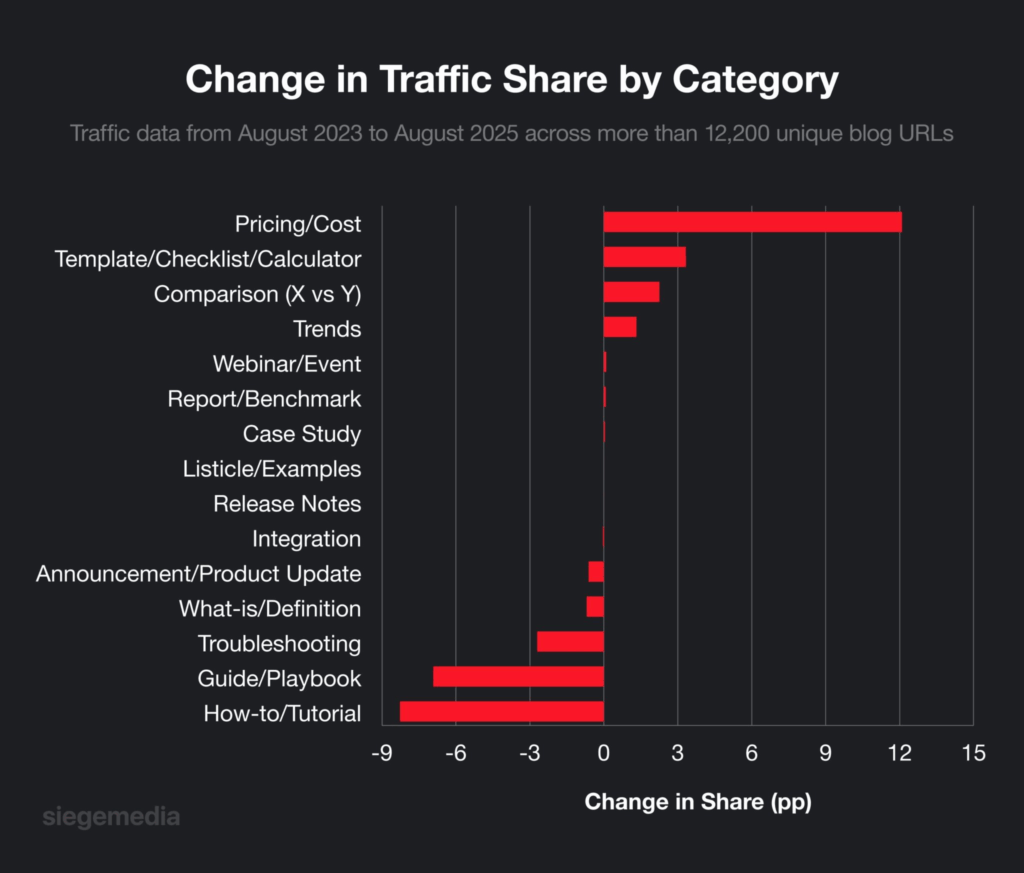
Classic TOFU formats – general guides and how-to posts – saw the steepest declines. In absolute terms, guide-style content traffic fell ~35% and “How to” content traffic plummeted by an alarming 88% over two years. Meanwhile, pricing-related articles shot up (+12.1% traffic share).
This dramatic downturn is attributed to the rise of AI search tools, which are now “increasingly answering the broad, top-of-funnel questions.” But remember, in that process they are displaying and referencing the brands providing them with the information they're using to generate the answer.
Even HubSpot – a pioneer in TOFU blogging – saw its blog traffic drop by ~70–75% after Google introduced AI summary answers in search. In Scrunch’s words, “AI-powered answers have started siphoning away the browsing traffic that once sustained publishers and brands.”
The upside? The traffic which does reach you is often highly qualified. As one report quipped, “users arrive at brand sites not to browse but to buy.” They may have outsourced the research phase to AI, but they noted who was referenced in the answer generation, and asked about them at the BOFU stage.
Generative AI is forcing marketers to rethink the role of TOFU content. This does not mean TOFU content is dead – rather, its format and purpose are evolving. Brands must ensure their foundational content still reaches the audience. Siege Media’s experts advise doubling down on depth and specificity: creating ultra-detailed guides and very specific long-tail content (the kind of nuanced information AI answers often lack). The goal is to provide unique expertise, data, and insight that adds value beyond a quick AI summary.
Buyer journey: From general queries to BOFU conversions
Think about your own buyer journey. You rarely start by searching for a brand name.
Marketing research consistently shows that buyer journeys start broad and gradually become more specific. TOFU content is what engages buyers during those early, exploratory searches.
- Most journeys begin with unbranded searches: A famous Google study found that 71% of B2B buyers start their research with a generic search query, not a branded one. Early in the journey, a buyer might search “best project management software.” TOFU content is what captures these searches.
- Self-directed research and content consumption: Today’s buyers do a ton of independent research. One survey noted that B2B buyers complete 57% of their purchase evaluation before ever talking to a sales rep or filling out a form. What are they doing in that time? They are reading, watching, and learning – often through your TOFU and MOFU content. As I mentioned above, the average buyer might consume 5–8 pieces of content.
- Transition to high-intent queries: As buyers move down the funnel, their queries change.
- They go from exploratory searches (“what is/ how do I...”)
- ...to evaluative searches (“X vs Y”, “best software for ___”)
- ...to transactional searches (“X pricing”, “buy ___ online”). TOFU content often initiates this process. In the Conductor study, when presented with multiple brand options, the vast majority chose the brand that had previously “helped” them.
- Surveyed buyer opinions: In Edelman and LinkedIn’s annual B2B buyer surveys, over 9 in 10 decision-makers say that thought leadership content plays a role in their purchasing process. Furthermore, 9 out of 10 B2B buyers overall say that online content has a moderate to major impact on their purchase decisions. Buyers recall which brands offered them valuable insights versus which ones only pushed sales messages.
The buyer’s path from awareness to conversion is paved with content.
Takeaways
So, what's the takeaway for those of us in the trenches?
Both academic studies and industry research concur that top-of-funnel content is a powerful driver of bottom-of-funnel success. It creates the essential awareness, knowledge, and trust without which later conversions would be scarce. It’s not just about attracting eyeballs – it’s about influencing minds, even in the era where that influence may come within the Google or ChatGPT interfaces, and not on your website. Yes, this is a nightmare for attribution and no - I haven't yet figured out a reliable workaround.
This pays off in the form of higher engagement, more leads, and ultimately more conversions – as evidenced by experiments (e.g., a 131% boost in purchase likelihood) and surveys (e.g., most buyers consume multiple content pieces).
It's tempting to cut the TOFU budget when attribution is hard. Smart marketers measure TOFU content not just by last-click attribution, but via multi-touch attribution, GEO visibility, and brand metrics. As Nielsen’s report put it, upper-funnel efforts might have a “delayed ROI,” but they “still contribute to short-term sales in addition to fostering a pipeline of future ones.”
Completely forgoing TOFU content is risky. You might see a short-term bump in efficiency, but over time you'll erode the brand equity and awareness needed to feed the funnel.
In the era of generative AI, the role of TOFU content is evolving but remains vital. AI may handle simple questions, yet it is brand-produced content that provides depth, context, and personality reference. Your brand, or your competitors'.
Sources
- Why focusing on the entire marketing funnel is key for long-term brand growth | Nielsen
- Educational Content Makes Consumers 131% More Likely to Buy
- 9.3 Who-Generated Content | Marketing Research
- 2025 Edelman-LinkedIn B2B Thought Leadership Impact Report
- 57 B2B Marketing Statistics 2025 (Growth & Trends)
- 2025 Edelman — LinkedIn B2B Thought Leadership Impact Report | Edelman
- Content Type Popularity and Engagement Trends [New Data]
- The end of browsing: How ChatGPT is collapsing the marketing funnel | Stacker
- How to Do Market Research: A Step-by-Step Guide to Understanding Your Buyer’s Journey
- How Mobile Has Redefined the Consumer Decision Journey for Shoppers
- Here’s How the Relationship Between B2B Buying, Content, and Sales Reps Has Changed