
Internet Marketing and AI blog
Mozcon 2016: Dr. Pete Meyers
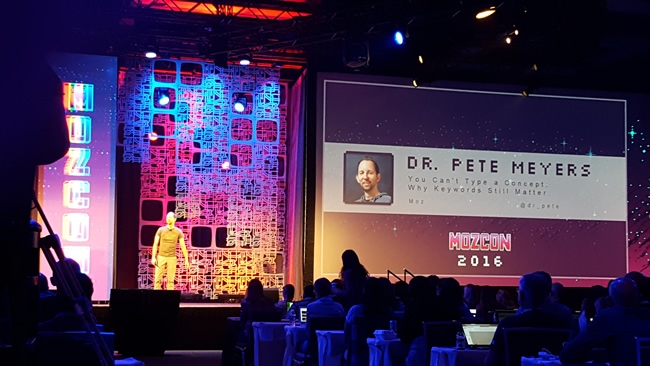
DISCLAIMER: This post is written as a live blog from Mozcon. There may be typos and grammar to make my high school English teachers weep. Please excuse those … it’s a fast-paced conference with back-to-back sessions and no time for proofing or even proper writing.Opening up day two of Mozcon 2016 is Dr. Pete Meyers. I've been looking forward to this session and hearing why he still thinks keywords matter. He begins by discussing how searches are evolving and not just how search is evolving. He points out that as searchers change Google needs to adapt and then we as marketers need to adapt. He used voice search as an example. It came to the forefront in 2013 and shortly thereafter Hummingbird rolled out. Hummingbird was built do deal with voice search an more complicated queries. Then in October 2015 Rankbrain rolled out. They have since rolled it out on a larger scale and Google is becoming a "machine learning first" company. To combat this and Google new ability to understand better user intent. To react we started believing and saying "build great content". That's great but to get that content someone has to enter a query. What's in that query is still important. He mocks us all for writing horrible title tags int he past like: Scraf, Scarves, Wraps :: Buy Scarves Online But now Google understands that scarf and scarves refer to the same thing. They also know that when you search "discount airfare" a page about "discount flights" refers tot he same thing. He lists a series of examples where Google understand the context not just the content. Where it gets more confusing is when there are multiple answers for a single query. He uses "blender" as an example that can refer to the kitchen implement, a movie or a rendering service. Doing so required deep learning. Which he's about try to explain ... Neural Networks attempt to model the human brain. We want to input data and output a result and the network is a hidden layer in the middle. This middle layer is taught how to deal with new information. We do this by starting with the output and determining the input and teaching the machine to work its way forward. The machine then learns how to teach itself. Google is using this. They offer a udacity course on it. This course basically defines how machine learning could be used at Google as "taking two inputs (query and page) and determining how likely they are to be releant". He brings up Tensorflow - a free machine learning offering from Google as an exaple that his is an area they are pushing heavily. He points out that Rankbrain is not query translation (which is a different thing). It's not an adjustment of our query but a quest for relevance.